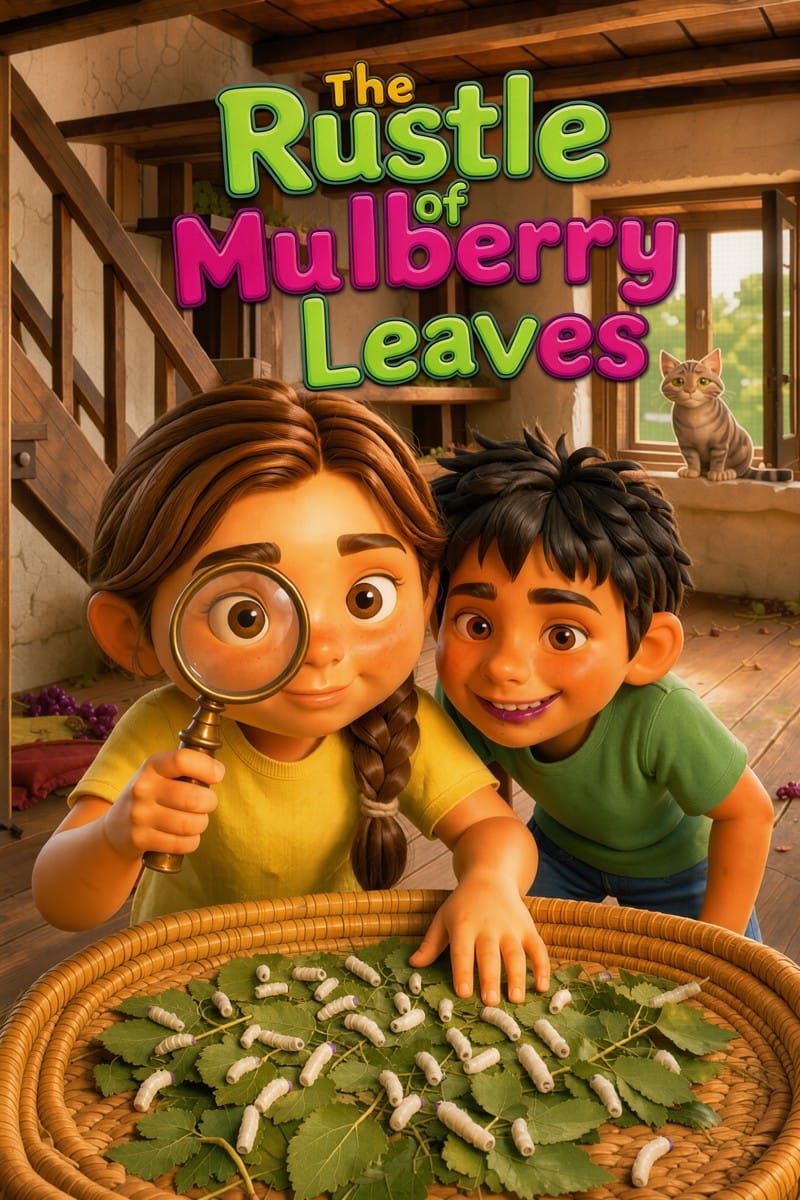
The Rustle of Mulberry Leaves
For three mornings now, a handful of Granny Hattie's silkworms has gone missing. Granny suspects Kieran, the mulberry-loving boy next door, while Aunt Sally blames Tabby, the street cat. But Daisy believes they're both innocent, and she can't prove it to anyone until she discovers what is really taking the caterpillars.
Free story — no account needed to read it.
8 Minutes
4 Endings
9-10
auto_stories Similar Stories


About This Story
“The Rustle of Mulberry Leaves” is an interactive educational story for children aged 9-10, about 8 minutes long. The reader decides how it goes at 5 choice points, and there are 4 different endings. It is free to read on Kitapz, with no account needed.
- Age range
- 9-10 years
- Reading time
- about 8 minutes
- Genre
- Educational
- Format
- Interactive · 5 choice points · 4 endings
- Language
- English, Turkish
- Access
- Free, no account needed
- Characters
- Mouse, Granny Hattie, Daisy, Kieran, Tabby, Aunt Sally
- Values
- Fairness, Friendship, Honesty
- Collections
- Educational stories, Stories for ages 9-10
- Reading support
- dyslexia-friendly font, bionic reading, color-blindness filters
An Excerpt from the Story
It was Friday evening, and the weekend was just beginning. Daisy hugged the basket she had filled from the mulberry trees in the garden and carried it up the creaky stairs. This was Granny Hattie's silkworm room. As soon as Granny Hattie spread the leaves over the straw trays, the caterpillars began to munch, and the whole room rustled as if it were raining.
But Granny Hattie was frowning. She pointed to the edge of the tray on the corner shelf. There were leaves there, but not a single caterpillar on them.
Granny Hattie:
“Three mornings in a row now, a whole handful gone each time. That Kieran keeps wandering around my garden in the evenings. Tonight I'm locking the gate, and we'll see what happens.”
Daisy frowned. Kieran from next door was her best friend.
Daisy (thinking):
What would Kieran want with caterpillars? It's not like he'd eat them.
Daisy (thinking):
Tomorrow morning, I'll be the first to check the trays.
“The Rustle of Mulberry Leaves” · Ages 9-10 · kitapz.com
school For Parents and Teachers
In this story, children help Daisy find out why a handful of caterpillars vanishes from Granny Hattie's silkworm room every morning. It introduces silkworms raised on mulberry leaves and explores the difference between looking guilty and being proven guilty, along with the pull of standing up for a best friend. Readers' choices decide how Daisy looks for proof.
What will children learn from this story?
- Learns that silkworms feed on mulberry leaves and are raised on straw trays in a room of their own.
- Practises ruling out a suspect by testing each possibility in turn, such as checking whether the window screen is torn or whether the stairs creak.
- Learns to spot what is unusual by first knowing what is normal, and to gather clues with simple tools like a magnifying glass or a layer of flour.
- Thinks about why blaming someone just because they look guilty can be unfair, and how to stand by a friend while still looking for the truth.
Curriculum links: Science, Life skills
Fact Box
What do silkworms eat?
Silkworm caterpillars eat only mulberry leaves, and their favorite is the white mulberry. Silkworms are fully domesticated: they do not exist in the wild and depend entirely on people to survive.
Source: Wikipedia
How much silk is in one silkworm cocoon?
A silkworm spins its cocoon from raw silk made in its salivary glands. The thread in one cocoon is about 300 to 900 m (roughly 1,000 to 3,000 ft) long.
Source: Wikipedia
Can a silkworm's droppings show whether it is healthy?
Yes. Silkworm caterpillars with a bacterial disease get dysentery and pass droppings that come out stuck together like a chain. Silk farmers are advised not to let droppings build up in the rearing beds.
Who buys silk cocoons from farmers in Turkey?
Kozabirlik, a cocoon cooperative union based in Bursa, produces silkworm eggs and gives them to farmers free of charge, box by box. Once the caterpillars have spun their cocoons, it buys the cocoons back from the farmers.
Source: Daily Sabah (Anadolu Agency)
Reading Comprehension Questions (5W1H)
The questions cover the opening that every reader sees, whatever they choose. Tap a question to see the answer.
-
Who? Who does Aunt Sally say is the culprit?
Answer: Tabby, the street cat she saw sitting outside Granny Hattie's window at night.
-
What? What has Granny Hattie noticed about the tray on the corner shelf?
Answer: For three mornings in a row, a handful of caterpillars has gone missing from it.
-
Where? Where are the empty spots in the trays always found?
Answer: Always on the same corner shelf.
-
When? When does the story begin?
Answer: On a Friday evening, just as the weekend is beginning.
-
Why? Why does Daisy decide that no cat could have got in through the window?
Answer: She runs her finger over the wire screen and finds not a single tear.
-
How? How does Daisy work out that Granny would hear anyone coming upstairs at night?
Answer: The top stair creaks loudly when she steps on it, and Granny's bed is right at the foot of the stairs.
Questions to Talk About After Reading
- At the first choice, did you send Daisy to ask Kieran straight out, or have her look for proof on her own without dragging him into it? Why did you pick that path?
- Granny Hattie and Aunt Sally each blame someone without seeing them touch the caterpillars. Have you ever been blamed for something you didn't do? How did it feel, and what would have helped?
- Daisy wants to stand up for her best friend, but she worries Granny will think she is just protecting him. Have you ever felt caught between trusting a friend and finding out the truth?
- If you did something without asking first, would you rather tell the grown-ups yourself or have them hear it from someone else? Why?
Word List
- culprit
- The person or animal who did something wrong.
- windowsill
- The flat ledge at the bottom of a window, where Tabby likes to sit.
- creak
- To make a long, squeaky sound, like an old wooden stair when you step on it.
- banister
- The rail along the side of a staircase that you hold on to.
- rolling pin
- A long, round wooden stick used to roll dough out flat.
- cocoon
- The soft case a silkworm caterpillar spins around itself out of silk thread.
Activity Idea
Sprinkle a thin layer of flour on a tray, and while the child is out of the room, have an adult make marks in it with a few household things, such as a fingertip, a fork or a toy car's wheels. The child then studies the tracks with a magnifying glass, works out which object made each one and explains how they decided.
Completion Rewards
What you'll earn when you finish this story: