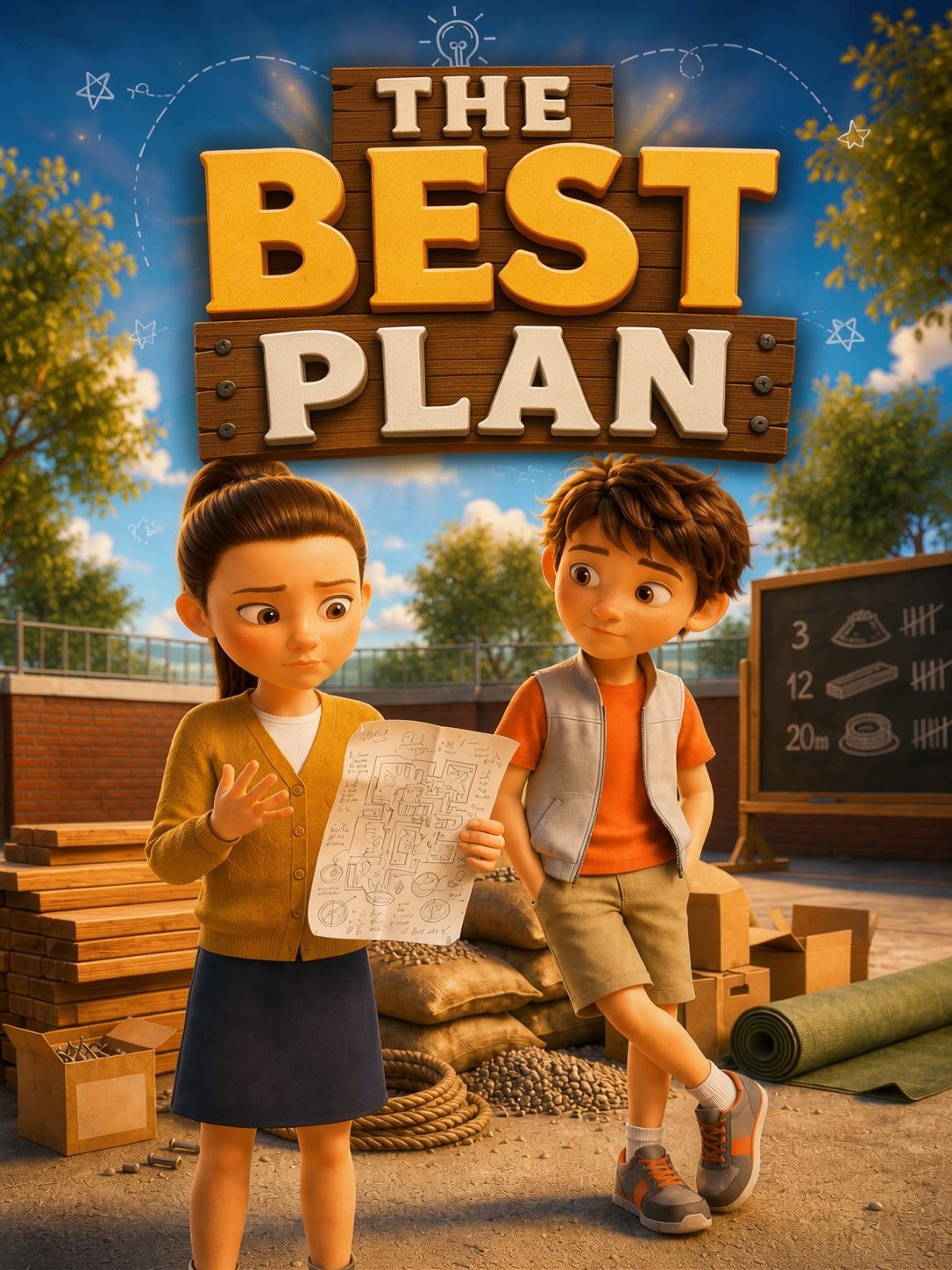
The Best Plan
Ivy is a girl who loves to plan everything carefully before she starts anything. One day, a mysterious pile of supplies left in the schoolyard sweeps her and her friends into an extraordinary weekend adventure. The schoolyard is full of needs waiting to be solved, but the supplies they can use are limited. As Ivy and her friends work together, they begin to discover that sometimes the best solution isn't doing everything at once, but starting where it matters most. The Best Plan is a heartwarming story about making plans, thinking together, and finding the right priorities, inviting children to discover the joy of creating, sharing, and deciding together.
Free story — no account needed to read it.
25 Minutes
3 Endings
8-10
auto_stories Similar Stories

About This Story
“The Best Plan” is an interactive educational story for children aged 8-10, about 25 minutes long. The reader decides how it goes at 6 choice points, and there are 3 different endings. It is free to read on Kitapz, with no account needed.
- Age range
- 8-10 years
- Reading time
- about 25 minutes
- Genre
- Educational
- Format
- Interactive · 6 choice points · 3 endings
- Language
- English, Turkish
- Access
- Free, no account needed
- Characters
- Ivy, Mia, Caleb, Rory
- Values
- Teamwork, Patience, Responsibility
- Collections
- Educational stories, Stories for ages 7-8, Stories for ages 9-10
- Reading support
- dyslexia-friendly font, bionic reading, color-blindness filters
An Excerpt from the Story
Ivy arrives at the schoolyard gate.
In the middle sits a huge pile of supplies under a tarp.
Ivy (thinking):
They're here all weekend. On Monday morning, the truck will take back whatever's left.
Ivy:
“Sacks, boards, ropes... Let's see exactly what we've got.”
She speeds up and heads toward the pile.
As Ivy nears the pile, Mia quietly comes up beside her.
Ivy:
“Sacks first. One, two, three sacks of gravel. Then the boards...”
Ivy pulls the tarp all the way off.
Ivy:
“A box of screws, a long rope and a roll of green fabric.”
Mia:
“I noticed something. The muddy path gets really crowded in the mornings.”
“The Best Plan” · Ages 8-10 · kitapz.com
school For Parents and Teachers
In this story, children help Ivy and her friends decide what to do when one pile of supplies can't fix all four of the schoolyard's problems. Careful planner Ivy works alongside Rory, who wants to start right away, observant Mia, and Caleb, whose pockets always hold something useful. Readers' choices decide which job the team tackles first.
What will children learn from this story?
- Practices counting the supplies on hand and comparing them with a list of needs to make a work plan.
- Thinks about what setting priorities means: choosing the most needed job first when there isn't enough for everything.
- Learns how on-the-spot observations, like footprints in the mud or where a shadow falls, can make a plan more accurate.
- Learns how measuring before cutting, pouring or hammering helps get a job right the first time.
Curriculum links: Maths, Life skills, Science
Fact Box
Why do seedlings wilt on hot days?
Plants are always losing water through tiny openings in their leaves, a process called transpiration. Heat, low humidity and wind speed it up so much that the roots can't keep up, even when the soil still has water, and the leaves droop. Plants usually recover in the cooler evening.
Why doesn't compacted soil soak up water?
Machinery, foot traffic and pounding rain press soil particles together, shrinking the spaces between them, so air and water move in slowly and roots struggle to grow. Because water runs off instead of soaking in, compacted soil can both puddle and dry out quickly. A layer of compost on top gradually loosens lightly compacted soil as earthworms pull it down.
How does a stick's shadow move during the day?
In places like Europe and the continental United States, the Sun on average rises in the east, crosses the south at noon and sets in the west. A shadow always falls on the side opposite the Sun, so a stick's shadow points west in the morning, north at noon and east in the evening, turning clockwise.
How do you keep a path across muddy ground firm?
According to the U.S. Forest Service trail notebook, the most important thing is to keep the water level below the path's base and carry water under and away from it at frequent intervals. On wet, soft ground a fabric called geotextile can be laid underneath: it lets water seep through but not soil, so the mud does not mix into the material on top.
Source: U.S. Forest Service / FHWA
Reading Comprehension Questions (5W1H)
The questions cover the opening that every reader sees, whatever they choose. Tap a question to see the answer.
-
Who? Who notices that the muddy path gets really crowded in the mornings?
Answer: Mia notices it and tells Ivy.
-
What? What problems do the kids find when they walk around the schoolyard?
Answer: Up front there are a muddy path and a wobbly bench, and in the back garden the soil is cracked, the seedlings are wilting and there's no shade at all.
-
Where? Where is the pile of supplies?
Answer: In the middle of the schoolyard, under a tarp.
-
When? When will the truck take back whatever is left?
Answer: On Monday morning, so the supplies are only there for the weekend.
-
Why? Why does Ivy stop Rory when he wants to open a sack right away?
Answer: She wants to look at and count the problems first, and only then share out the supplies.
-
How? How does Ivy feel when Rory starts dragging a sack of gravel without waiting?
Answer: She thinks they should have measured first, feels her plan falling apart and squeezes the paper in her hand.
Questions to Talk About After Reading
- At the first choice, did you have Ivy stop Rory and explain her plan, or quietly go back to her list? If you were Ivy, which would be easier for you, and why?
- If the supplies couldn't fix everything, which problem would you solve first: the muddy path, the wobbly bench, the seedlings or the missing shade? Why?
- Ivy likes to work everything out first, while Rory likes to start right away. Which one are you more like? Can you remember a time when both ways turned out to be useful?
- Everyone on a team can have a different strength: Mia notices things carefully, and Caleb saves useful bits and pieces. What do you bring most to a group project?
Word List
- tarp
- A big, strong waterproof sheet used to cover things and keep off rain and sun.
- seedling
- A young plant that has just grown from a seed.
- wilt
- To droop and go limp, as a plant does when it isn't getting enough water.
- gutter
- A long, open channel along the edge of a roof that catches rainwater and carries it down.
- tape measure
- A long strip marked with centimeters that rolls up into a case and is used to measure length.
- drainage
- Carrying extra water away from the ground through a channel or pipe.
Activity Idea
At home or in class, pick three or four small jobs that need doing (a messy cupboard, a dried-out pot plant) and write on the board how much time or material you have, for example 20 minutes and one roll of tape. Like Ivy, put the jobs in order of importance, start with the most important one, and at the end mark what got done and what is still waiting, leaving a note for next time.
Completion Rewards
What you'll earn when you finish this story: