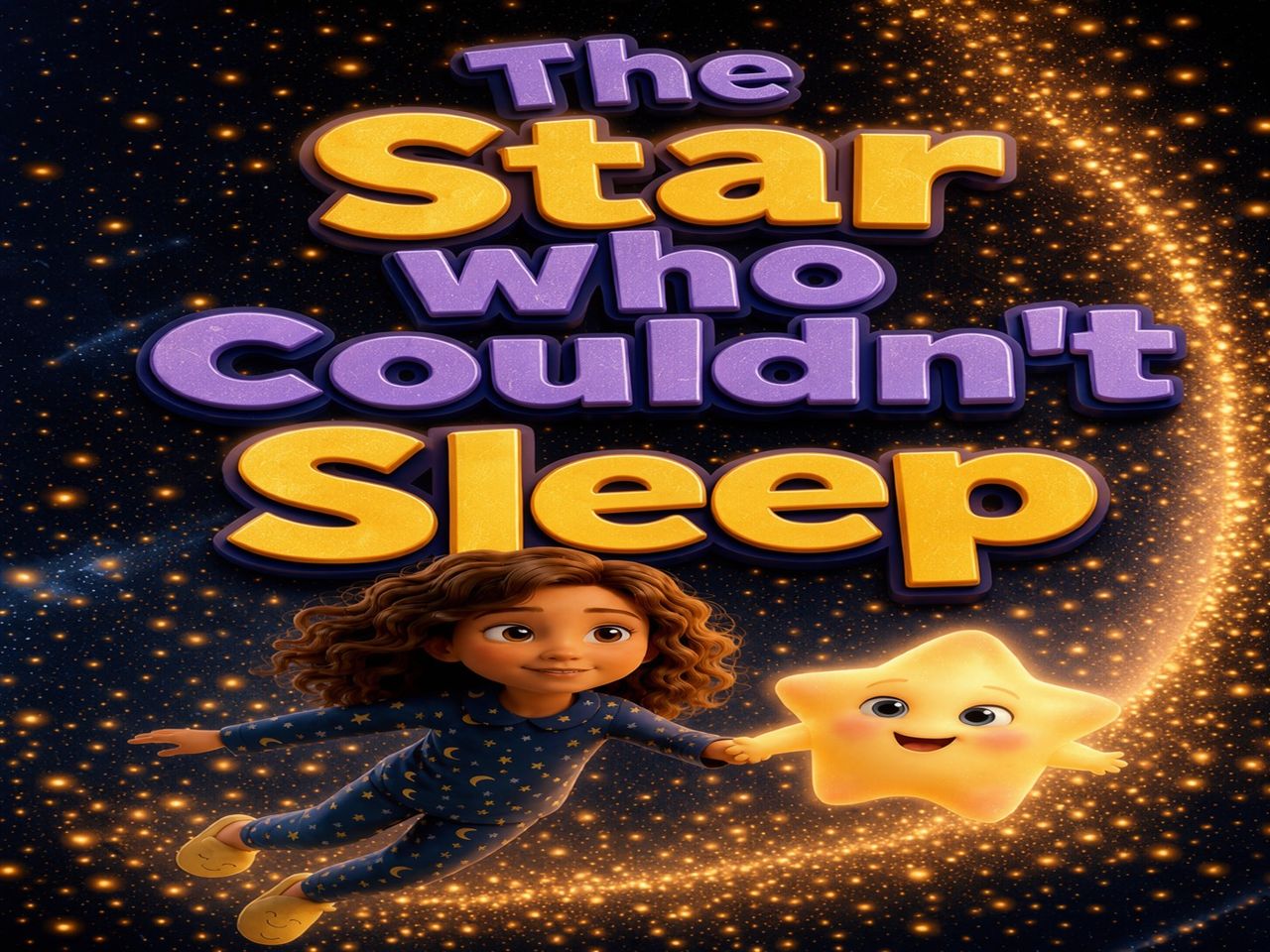
The Star Who Couldn't Sleep
THE STAR WHO COULDN'T SLEEP Ellie is a curious child who loves watching the night sky. While everyone else is fast asleep, the same question keeps twirling through her mind: Do stars sleep too? One night, a tiny light appears at her window and invites Ellie on a magical journey through a sky full of stars. As she uncovers the secrets of the night sky, she begins to learn how special it is to shine, to rest, and to find your very own place. Glowing with curiosity, friendship, and calm, The Star Who Couldn't Sleep is a warm and cozy sky adventure that invites children to discover the quiet beauty of the night. A peaceful, star-filled story where imagination meets science for young readers.
25 Minutes
3 Endings
7-10
auto_stories Similar Stories
About This Story
“The Star Who Couldn't Sleep” is an interactive educational story for children aged 7-10, about 25 minutes long. The reader decides how it goes at 3 choice points, and there are 3 different endings. It is available to Kitapz Premium subscribers; the opening is free to read below.
- Age range
- 7-10 years
- Reading time
- about 25 minutes
- Genre
- Educational
- Format
- Interactive · 3 choice points · 3 endings
- Language
- English, Turkish
- Access
- With a Premium subscription
- Characters
- Shepherd, Ellie, Twinkle, Granny Moon
- Values
- Curiosity, Friendship, Empathy
- Collections
- Educational stories, Stories for ages 7-8, Stories for ages 9-10
- Reading support
- dyslexia-friendly font, bionic reading, color-blindness filters
An Excerpt from the Story
Ellie tosses and turns in her bed.
Ellie (thinking):
I wonder where clouds sleep at night?
Ellie (thinking):
I wonder if ants have dreams too? And what about fish?
Ellie:
“Ugh... My head is buzzing like a beehive!”
Ellie:
“I must be a daytime star. I switch on at night!”
She pushes the quilt off, then pulls it back on. Her eyes are wide open.
Ellie (thinking):
Maybe if I look out the window, my questions will settle down... I wonder?
Ellie pushes the quilt aside and tiptoes quietly to the window.
Ellie:
“Wow! The sky is full of lights tonight!”
She leans against the glass. The stars blink their tiny blinks.
“The Star Who Couldn't Sleep” · Ages 7-10 · kitapz.com
school For Parents and Teachers
In this story, children join Ellie, who is too full of questions to sleep, and Twinkle, a tiny star afraid to rest in case she goes out, on Granny Moon's trip across the night sky. They wonder why stars twinkle, and the story gently opens up talk about bedtime worries and rest. Readers' choices shape where the trip goes.
What will children learn from this story?
- Learns that stars seem to twinkle because their light wobbles as it passes through Earth's air.
- Learns that the Moon and the planets don't make their own light but reflect light from the Sun.
- Notices that saying a fear out loud, and knowing someone is beside you, can help you feel calmer.
- Thinks about rest and sleep as a way of building strength back up rather than losing something.
Curriculum links: Science, Life skills
Fact Box
Why do stars twinkle?
The twinkling comes from Earth's atmosphere, not from the stars themselves. Moving pockets of air with different densities bend starlight slightly, and because stars are so far away that they look like single points, their light seems to shift and flicker from moment to moment.
Source: NASA Imagine the Universe
Why don't planets twinkle as much as stars?
Planets are much closer to us, so even though they look like points to the naked eye, they are really tiny discs in the sky. Their light comes through many different pockets of air at once, so the wobbles average out and planets look steady.
Source: NASA Imagine the Universe
Does the Moon make its own light, and why does its shape change?
The Moon does not make its own light; it shines with sunlight bouncing off its surface. The Sun always lights half of the Moon, and as the Moon travels around Earth we see more or less of that lit half, so the phases repeat about every 29.5 days.
Source: NASA Science
How much sleep does a primary-school child need?
An expert panel of the American Academy of Sleep Medicine recommends that children aged 6 to 12 sleep 9 to 12 hours per 24 hours on a regular basis. The panel links getting the recommended amount of sleep regularly with better attention, behavior, learning, memory and emotional regulation.
Reading Comprehension Questions (5W1H)
The questions cover the opening that every reader sees, whatever they choose. Tap a question to see the answer.
-
Who? Who invites Ellie and Twinkle on a trip across the sky?
Answer: Granny Moon, whose kind face appears in the sky outside the window.
-
What? Which two lights does Ellie notice as they drift across the sky?
Answer: A great big light that shines strong and steady without flickering, and lots of stars all flickering together.
-
Where? Where does the little light land when it floats down from the sky?
Answer: On Ellie's windowsill.
-
When? When do Ellie's questions keep going round and round?
Answer: At night in bed, which is why she can't fall asleep.
-
Why? Why does Twinkle never stop flickering?
Answer: She is afraid that if she rests, she will go out and never light up again.
-
How? How do Ellie and Twinkle rise into the sky?
Answer: Light spills from Granny Moon's stardust shawl, wraps them up softly, and they begin to float upward.
Questions to Talk About After Reading
- In the sky, did you fly first to the big light that never flickers, or to the stars that flicker together? Why did you choose that way, and what do you think might happen on the other path?
- Ellie's head is full of 'I wonders' at night. Do questions pop into your head when you go to bed? What helps you calm them down?
- Twinkle is afraid she will go out if she rests. How do you feel when you are very tired? And how do you feel after a rest or a good night's sleep?
- When Twinkle shares her fear, Ellie doesn't laugh; she shares her own worry too. How could you help a friend who tells you they are scared of something?
Word List
- windowsill
- The narrow ledge along the bottom of a window, where the little star first lands.
- halo
- A glowing ring of light around something bright, like a star or the Moon.
- cluster
- A group of things close together; in the story, lots of stars shining near one another.
- crescent
- The thin, curved shape the Moon has when only a small part of it is lit.
- rhythm
- A pattern that repeats again and again, like breathing in and out.
- lullaby
- A soft, gentle song sung to help a child fall asleep.
Activity Idea
For one month, look at the Moon with a grown-up from a window or balcony each evening and draw its shape in a notebook with the date; on evenings you can't see it, write "not visible." At the end of the month, lay the drawings side by side and talk about how the Moon's shape changed.
Completion Rewards
What you'll earn when you finish this story: