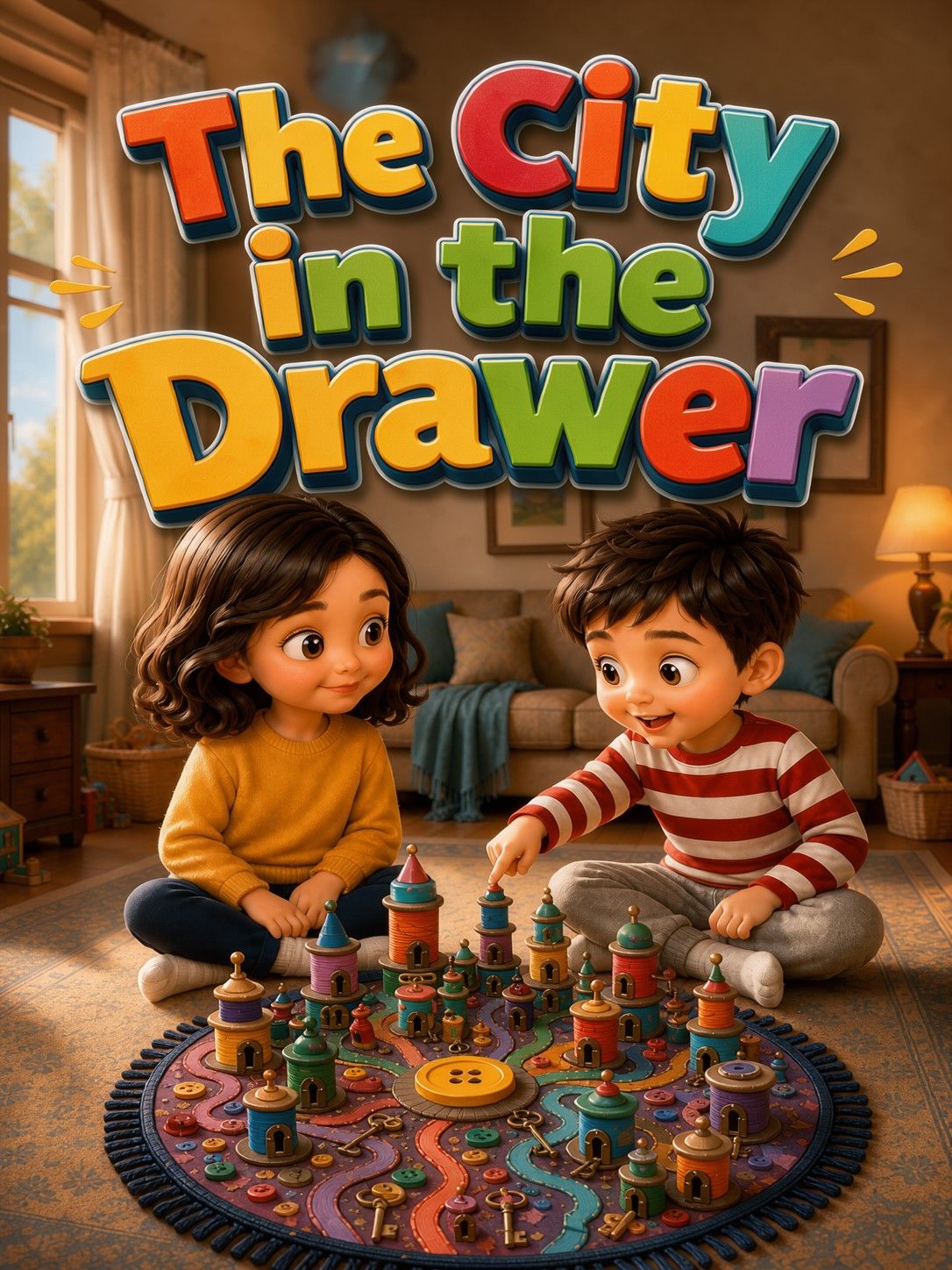
The City in the Drawer
The rain just won't stop, and River is terribly bored. She can't go outside, and it seems there's nothing at all to do inside the house. Then her eyes land on a drawer full of old and wonderfully curious things. A matchbox, a few buttons, colorful paper, and little forgotten bits and pieces… In River's imagination, each one begins to take on a whole new meaning. Before long, these ordinary objects become pieces of a brand-new world. A story about imagination, creativity, and the warmth of sharing, The City in the Drawer invites children on a heartwarming adventure that reminds them just how much there is to discover, even on the most ordinary of days.
15 Minutes
3 Endings
7-10
auto_stories Similar Stories

About This Story
“The City in the Drawer” is an interactive educational story for children aged 7-10, about 15 minutes long. The reader decides how it goes at 3 choice points, and there are 3 different endings. It is available to Kitapz Premium subscribers; the opening is free to read below.
- Age range
- 7-10 years
- Reading time
- about 15 minutes
- Genre
- Educational
- Format
- Interactive · 3 choice points · 3 endings
- Language
- English, Turkish
- Access
- With a Premium subscription
- Characters
- Danny, River, Big Button
- Collections
- Educational stories, Stories for ages 7-8, Stories for ages 9-10
- Reading support
- dyslexia-friendly font, bionic reading, color-blindness filters
An Excerpt from the Story
River:
“Rain again... always rain.”
River leans against the window and watches the drops slide down.
River (thinking):
I want to do something, but what?
River:
“Am I really going to sit here all day?”
There's a little wiggle inside her that just won't stop.
River (thinking):
I wonder what I could discover today?
River gets up from the window and wanders back and forth across the room.
River:
“I've played with this teddy bear a hundred times. I'm bored of it now.”
She looks at her toys, but she doesn't feel like touching any of them.
River (thinking):
They're all old... all the same as always.
“The City in the Drawer” · Ages 7-10 · kitapz.com
school For Parents and Teachers
In this story, children follow River on a rainy day as she turns buttons, spools, keys and ribbons from her mom's drawer into a world on the rug. It invites talk about how boredom can spark imagination and why sharing something you made can feel hard. Readers' choices decide whether River follows her curiosity and how much she shares.
What will children learn from this story?
- Discovers how ordinary things like buttons, spools, keys and ribbons can become pieces of an imagined world.
- Notices that boredom can push you to look for a new game or idea.
- Practices weighing up two options when curiosity and doubt pull in different directions.
- Thinks about why sharing something you worked hard on can feel difficult, and what working together can bring.
Curriculum links: Art, Life skills, Language arts
Fact Box
Can boredom make you more creative?
Some experiments suggest it can. In a study presented in 2013 by psychologists from the University of Central Lancashire, people who first spent 15 minutes copying numbers out of a phone book were more creative when they then listed uses for a pair of polystyrene cups than people who skipped the dull task. The researchers think boring tasks leave the mind room to daydream.
Source: ScienceDaily
What is loose parts play?
It is play with materials that children can move, combine and use in many ways, such as natural materials, building pieces, scrap and random found objects. The idea comes from the British painter and sculptor Simon Nicholson, who argued in a 1971 essay that the creativity and discovery possible in a place depend on the number and kind of variables in it. His theory has been influential in playwork and early education.
Source: Wikipedia
Why is play important for children's development?
In its 2018 report "The Power of Play", the American Academy of Pediatrics describes play as brain building, a key to executive function skills such as planning and self-control, and a buffer against the harmful effects of stress. It also says play helps children learn language, math and social skills, and that play with parents and peers is fundamentally important.
Source: American Academy of Pediatrics (HealthyChildren.org)
How long have people used buttons?
The oldest known button-like objects come from the Indus Valley and date to about 2800-2600 BC, but they were used as ornaments or seals, not to fasten clothes. Buttonholes for fastening clothing first appeared in Germany in the 13th century.
Source: Wikipedia
Reading Comprehension Questions (5W1H)
The questions cover the opening that every reader sees, whatever they choose. Tap a question to see the answer.
-
Who? Whose drawer does River notice in the corner?
Answer: It's her mom's drawer; it has always been there, but River has never really noticed it before.
-
What? What does River imagine might be inside the drawer?
Answer: Sparkly stones, old letters, or something totally different that she could never guess.
-
Where? Where does River watch the rain from at the start of the story?
Answer: She leans against the window and watches the drops slide down the glass.
-
When? When does River first notice the drawer?
Answer: When she gets bored of her toys, wanders around the room and her eyes land on the old furniture in the corner.
-
Why? Why doesn't River want to play with her toys?
Answer: They all feel old and the same as always, and she wants something new she has never seen before.
-
How? How does the drawer open when River first tugs the handle?
Answer: It doesn't open all the way, and River thinks it's stuck.
Questions to Talk About After Reading
- At the first choice, did you have River open the drawer, or go back to the window? Why did you pick that path?
- Have you ever turned an everyday thing at home into a new game on a boring day? What did it become?
- If you found something like the big yellow button in the story, something that doesn't seem to fit anywhere, what would you turn it into?
- How would you feel if your brother, sister or a friend wanted to join in with something you had worked hard on? When is sharing hard for you, and when is it easy?
Word List
- spool
- A small tube with a hole through the middle that thread is wound around.
- ribbon
- A long, narrow strip of colorful cloth used for tying or decorating things.
- worn
- Rubbed thin and old from being used for a long time, like the wood of River's mom's drawer.
- doubt
- A feeling of not being sure whether to do something.
- creaky
- Making a squeaking sound when it moves, like an old door.
- town square
- An open space in the middle of a town where people gather and meet.
Activity Idea
Use small things from around the house, such as buttons, spools, empty boxes, ribbons and clothespins, to build a tiny city together on the rug or a table; then each person picks one corner and tells a short story about someone who lives there. If there are toddlers at home, keep small pieces like buttons out of their reach.
Completion Rewards
What you'll earn when you finish this story: