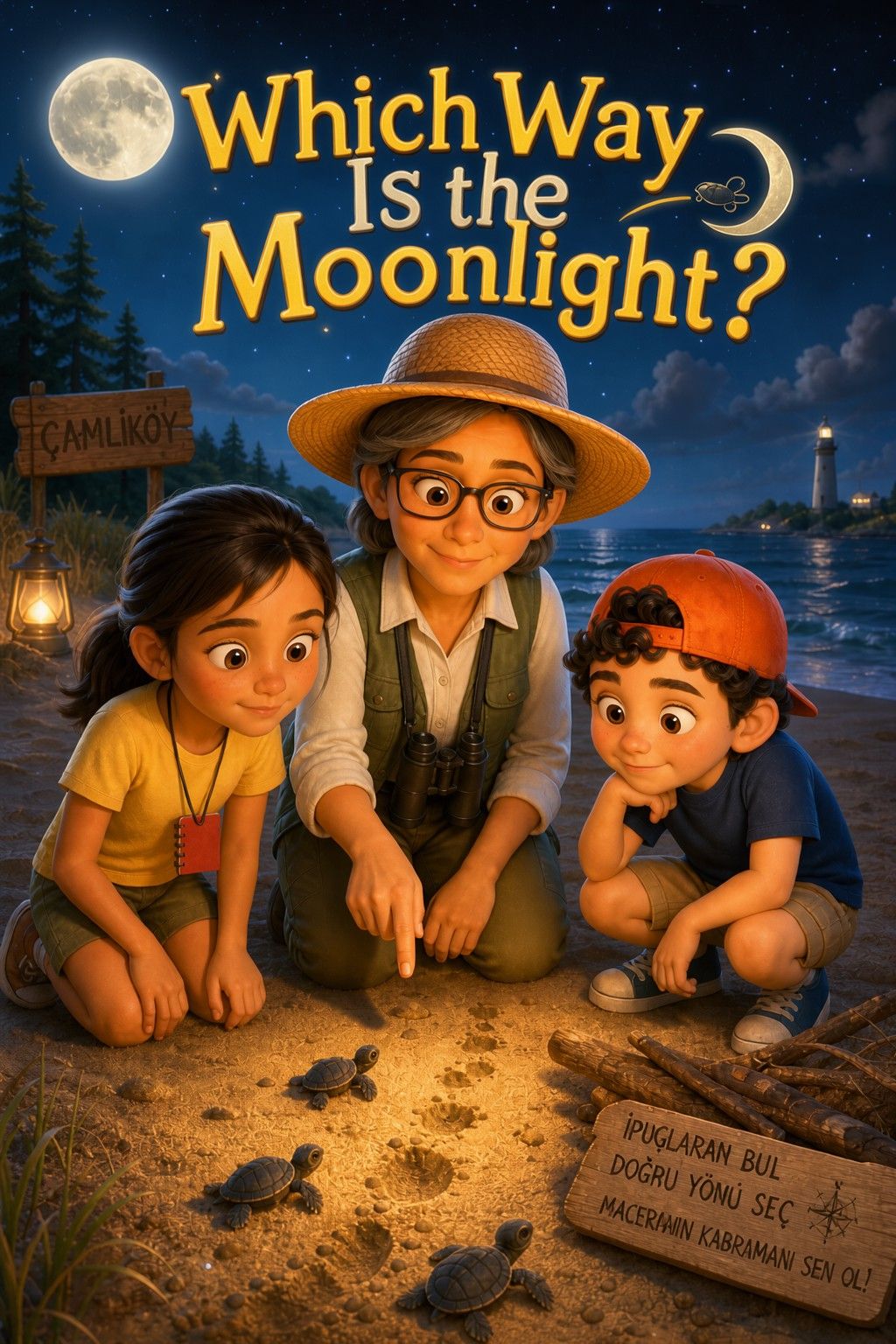
Which Way Is the Moonlight?
One morning on Çamlıkoy Beach, the baby turtles' tiny tracks lead not to the sea, but toward the road! Daphne and her cousin Kieran, visiting from Istanbul, must discover what led the little hatchlings astray before the next nest opens. Tracks in the sand, freshly cut branches, the deep darkness of night... You get to choose which clue to follow!
Free story — no account needed to read it.
15 Minutes
4 Endings
9-10
auto_stories Similar Stories
About This Story
“Which Way Is the Moonlight?” is an interactive nature story for children aged 9-10, about 15 minutes long. The reader decides how it goes at 5 choice points, and there are 4 different endings. It is free to read on Kitapz, with no account needed.
- Age range
- 9-10 years
- Reading time
- about 15 minutes
- Genre
- Nature
- Format
- Interactive · 5 choice points · 4 endings
- Language
- English, Turkish
- Access
- Free, no account needed
- Characters
- Dr. Ashley, Daphne, Kieran, Sam, Granny Nora, Zoe (Daphne's mom), The Village Neighbors, The Baby Turtles
- Values
- Caring for nature, Curiosity, Empathy
- Collections
- Nature stories, Stories for ages 9-10
- Reading support
- dyslexia-friendly font, bionic reading, color-blindness filters
An Excerpt from the Story
As the sun was just coming up, Daphne followed her mom, Zoe, down to the beach. Zoe was on the volunteer team, and her job was to protect the nests. Most mornings, Daphne simply tagged along.
Beside the cage around the fourth nest, they both stopped at once. There were tiny flipper tracks in the sand. But the tracks didn't lead to the sea. They stretched back toward the sand dune behind them.
Daphne (thinking):
The sea is right in front of them. Why did they go the wrong way?
Zoe (Daphne's mom):
“Don't touch them, sweetheart. We'll gather them up.”
Zoe and the other volunteers found the worn-out hatchlings one by one at the bottom of the bushes. They put them in a bucket of wet sand and set them down at the water's edge. Daphne waited with her hands on her knees. When the last hatchling slipped into the waves, she let out a deep breath.
“Which Way Is the Moonlight?” · Ages 9-10 · kitapz.com
school For Parents and Teachers
In this story, children help Daphne and her cousin Kieran find out why baby turtles crawled toward the dune instead of the sea, drawing the tracks and checking the volunteer team's records. It shows how hatchlings find the sea and why dark nights matter to wildlife. Readers' choices decide what Daphne investigates first and how she tackles the problem.
What will children learn from this story?
- Learns that sea turtle hatchlings head for the brightest part of the horizon, which on a natural beach is the sea.
- Practises ruling out an explanation with evidence by drawing each track and seeing where they all meet.
- Learns how dated records, like the team's notebook and the date on a nest stake, help show when a problem began.
- Thinks about why it matters not to touch wild animals, to stay quiet and to keep lights low when watching them.
Curriculum links: Science, Environmental education
Fact Box
How do sea turtle hatchlings find the sea?
Hatchlings crawl away from the dark outline of the dunes and plants on the land side and toward the brightest part of the horizon. On a natural beach with no artificial lights, that brightest horizon is over the open sea.
Source: NOAA Fisheries
How do lights near the beach harm baby sea turtles?
Artificial lights near the shore can outshine the natural glow over the sea and draw hatchlings toward land instead. There they may be eaten by predators, run over or drown in swimming pools. Sea Turtle Conservancy says about 100,000 hatchlings are disoriented by artificial lighting in Florida alone every year.
Source: Sea Turtle Conservancy
How long do sea turtle eggs take to hatch?
The eggs incubate in the sand for 45 to 65 days, depending on the species and the sand temperature. The hatchlings work together to dig up to the surface and generally wait until night to come out and head for the ocean.
Which sea turtles nest in Turkey?
Two species nest on Turkey's coasts: the loggerhead (Caretta caretta) and the green turtle (Chelonia mydas). Turkey's Ministry of Agriculture and Forestry has designated 20 important nesting areas; in 2024 it recorded 10,159 loggerhead nests and 2,394 green turtle nests, protecting them with cages placed under or on top of the sand.
Source: Turkish Ministry of Agriculture and Forestry (in Turkish)
Reading Comprehension Questions (5W1H)
The questions cover the opening that every reader sees, whatever they choose. Tap a question to see the answer.
-
Who? Who tells the children that a hatchling walks toward the brightest part of the horizon?
Answer: Dr. Ashley, the marine biologist who leads the team, tells them over the phone.
-
What? What do Daphne and her mom find in the sand beside the fourth nest?
Answer: Tiny flipper tracks that lead back toward the sand dune instead of to the sea.
-
Where? Where do all the tracks come together?
Answer: At a gap on the dune where the pink-flowered tamarisk bushes have just been cut down and the road behind can be seen.
-
When? When were the eggs in the fifth nest laid, and when should the nest hatch?
Answer: They were laid on July 7, and since eggs hatch about two months later, the nest should open within a few nights.
-
Why? Why does Daphne think something new must have happened in the last few days?
Answer: The team's notebook shows that the hatchlings from the first three nests all went to the sea.
-
How? How does Daphne work out that the streetlamp did not pull the babies?
Answer: She draws every track and sees that they all meet at one spot on the dune, while the streetlamp is in a completely different direction.
Questions to Talk About After Reading
- At the first choice, did you have Daphne follow the branch trail right away, or wait for the night to catch the light? Why did you pick that path?
- Kieran talks excitedly and films on the beach, while Daphne signals him to be quiet. How do you think people should behave when they watch a wild animal?
- If someone was harming nature without realizing it, how would you tell them? Why might it help to listen to them first?
- What lights are on at night where you live? Could they be a problem for birds, insects or other animals?
Word List
- hatchling
- A baby animal that has just come out of its egg, like the little turtles in the story.
- flipper
- A flat, wide limb that a sea turtle uses to swim and to crawl across the sand.
- dune
- A hill of sand piled up by the wind, usually just behind a beach.
- tamarisk
- A shrub or small tree with slender branches and tiny pink or white flowers that can grow in salty soil; in the story, tamarisk bushes grow on the dune.
- sawdust
- The tiny crumbs of wood that fall off when wood is sawn.
- stake
- A pointed stick pushed into the ground; in the story, one marks a nest and shows the date the eggs were laid.
Activity Idea
On an evening walk with an adult around your home or school, list the lights that shine up into the sky, onto trees or across empty ground. Back home, talk about which ones are really needed and which animals they might disturb.
Completion Rewards
What you'll earn when you finish this story: