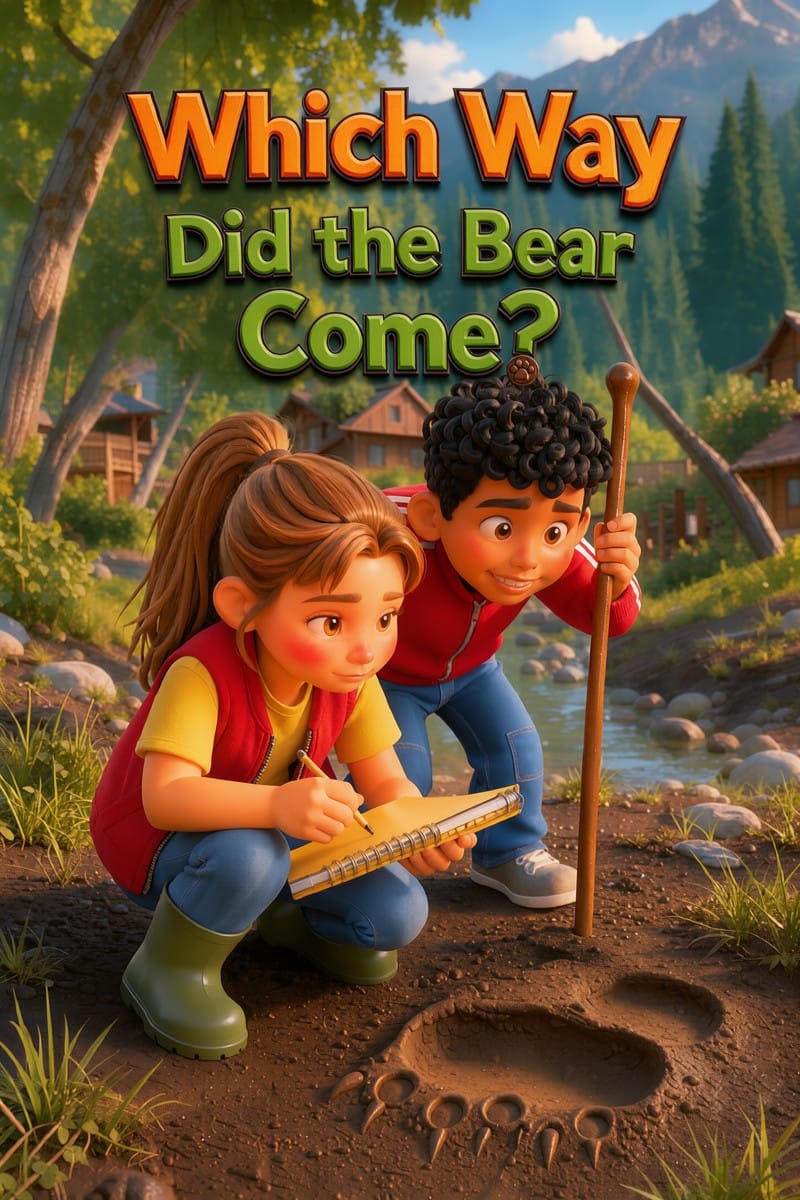
Which Way Did the Bear Come?
One morning, in a lush green highland village in Şavşat, Granny Hattie's garden beehives have been knocked over, and tufts of dark brown fur are left on the fence wires. Yet no one has touched the old log hives up in the trees. Without ever seeing the bear, can Ella use only the tracks it left behind to find out which path it came by, and what drew it here this year?
Free story — no account needed to read it.
15 Minutes
4 Endings
9-10
auto_stories Similar Stories

About This Story
“Which Way Did the Bear Come?” is an interactive nature story for children aged 9-10, about 15 minutes long. The reader decides how it goes at 5 choice points, and there are 4 different endings. It is free to read on Kitapz, with no account needed.
- Age range
- 9-10 years
- Reading time
- about 15 minutes
- Genre
- Nature
- Format
- Interactive · 5 choice points · 4 endings
- Language
- English, Turkish
- Access
- Free, no account needed
- Characters
- Bobby, Ella, Uncle Hank, Uncle Hank's dog, Sally, Granny Hattie
- Values
- Curiosity, Caring for nature, Teamwork
- Collections
- Nature stories, Stories for ages 9-10
- Reading support
- dyslexia-friendly font, bionic reading, color-blindness filters
An Excerpt from the Story
Ella woke to a worried voice coming from the garden. Granny Hattie was calling her. She pulled Granny Hattie's green cardigan, which came down to her knees, over her pajamas, put on her boots and dashed out the door.
Two of the four blue beehives had tipped over. Honeycombs were scattered across the grass, and the bees were buzzing around in a frenzy. On the wire fence by the stream, tufts of dark brown fur were fluttering.
Granny Hattie:
“A bear came down, sweetheart. It smelled the honey in the night and came looking.”
Ella put her hand over her mouth. A bear had come just a few steps from the room where she was sleeping. A shiver ran down the back of her neck, but she couldn't take her eyes off the fur.
Ella (thinking):
I didn't hear a thing. But where did it come from?
“Which Way Did the Bear Come?” · Ages 9-10 · kitapz.com
school For Parents and Teachers
In this story, children help Ella track the bear that knocked over her granny's beehives without going near it, using fur on a wire, prints in the mud and a camera trap's photos. Uncle Hank wants to move the hives and Granny Hattie wants them to stay, so Ella weighs the evidence. Readers' choices decide which clues she follows.
What will children learn from this story?
- Learns how signs such as a footprint in mud, fur caught on a wire, broken branches and flattened grass can show where an animal has walked.
- Learns that a camera trap takes pictures by itself when a warm animal walks past, and why it matters where you point it.
- Learns that brown bears are protected, and why it is important to keep away from a bear and stay indoors at night, even when you are curious about it.
- Thinks about listening to two grown-ups who want the same thing in different ways, and about basing a decision on evidence rather than guesses.
Curriculum links: Science, Environmental education, Life skills
Fact Box
How can you tell a bear track from a dog track?
Count the toes. Bears leave five toe prints on both their front and hind feet, while dogs and their wild relatives, such as wolves and foxes, leave four. Dog tracks can show claw marks too, so claw marks alone are not enough.
Source: National Wildlife Federation
What is a camera trap and how does it work?
A camera trap is a camera that records wild animals by itself when researchers are not there. Most are set off by a passive infrared sensor that picks up movement and an animal's body heat. Scientists use them to detect rare species and study animals' behavior with very little disturbance.
Source: Wikipedia
How can people stay safe in places where bears live?
Most bears avoid people if they hear them coming, so it helps to make some noise and to walk in a group rather than alone, since groups are noisier. Above all, keep your distance and never try to approach a bear.
Source: National Park Service
Why do beekeepers in Artvin put hives up in trees?
To protect them from bears. Beekeepers in the Murgul district of Artvin, in northeastern Turkey, place their traditional hives in tall hornbeam trees in early spring, choosing trunks too big and thick for bears to climb. At harvest time they climb up with a ladder, or with a rope if there is no ladder.
Source: TRT Haber (in Turkish)
Reading Comprehension Questions (5W1H)
The questions cover the opening that every reader sees, whatever they choose. Tap a question to see the answer.
-
Who? Who suggests taking all the hives down to town in a pickup truck?
Answer: Uncle Hank, a beekeeper neighbor who keeps his own hives at the other end of the village.
-
What? What does Ella see when she runs out into the garden in the morning?
Answer: Two of the four blue beehives have tipped over, honeycombs are scattered across the grass, and tufts of dark brown fur are fluttering on the wire fence.
-
Where? Where are Granny Hattie's log hives?
Answer: They hang by ropes from the branches of tall spruce trees in the meadow behind the house.
-
When? At what time of year does Granny Hattie say you shouldn't move hives?
Answer: At the end of August, because the bees get worn out on the road and go into winter weak.
-
Why? Why has Granny Hattie wrapped the tree trunks in tin?
Answer: So that a bear trying to climb up can't grip the tin with its claws and slides right down.
-
How? How does the camera trap that Sally leaves behind work?
Answer: You strap it to a tree, and when a warm animal walks past, it takes a picture all by itself.
Questions to Talk About After Reading
- At the first choice, did you send Ella to follow the tracks with Bobby, or set up the box in the garden and wait for the night pictures? Why did you pick that path?
- Uncle Hank wants to move the hives and Granny Hattie wants them to stay, but both are trying to protect the bees. If you were Ella, how would you decide between their ideas?
- Ella is very curious about the bear, but she wants to find it without getting close. How could you find out about an animal or a place you're curious about without putting yourself in danger?
- What can people do so that bears, bees and people can all live safely in the same village?
Word List
- honeycomb
- The wax sheets of six-sided cells that bees build to store honey and raise their young.
- log hive
- An old-style beehive made from a thick, hollowed-out log; in the story they hang by ropes from tree branches.
- spruce
- A tall evergreen tree with short, needle-like leaves that stays green all winter.
- camera trap
- A small camera strapped to a tree or post that takes pictures by itself when an animal walks past.
- tuft
- A small bunch of hair or fur, like the dark brown fur caught on the fence wires.
- meadow
- A field covered with grass and wild flowers.
Activity Idea
Spread damp sand on a tray or roll out some play dough, and let one person make tracks with their fingers, a toy animal's feet or a bottle cap while the others look away. The others then guess what made each track and which way it was going, and measure and draw the prints in a notebook.
Completion Rewards
What you'll earn when you finish this story: