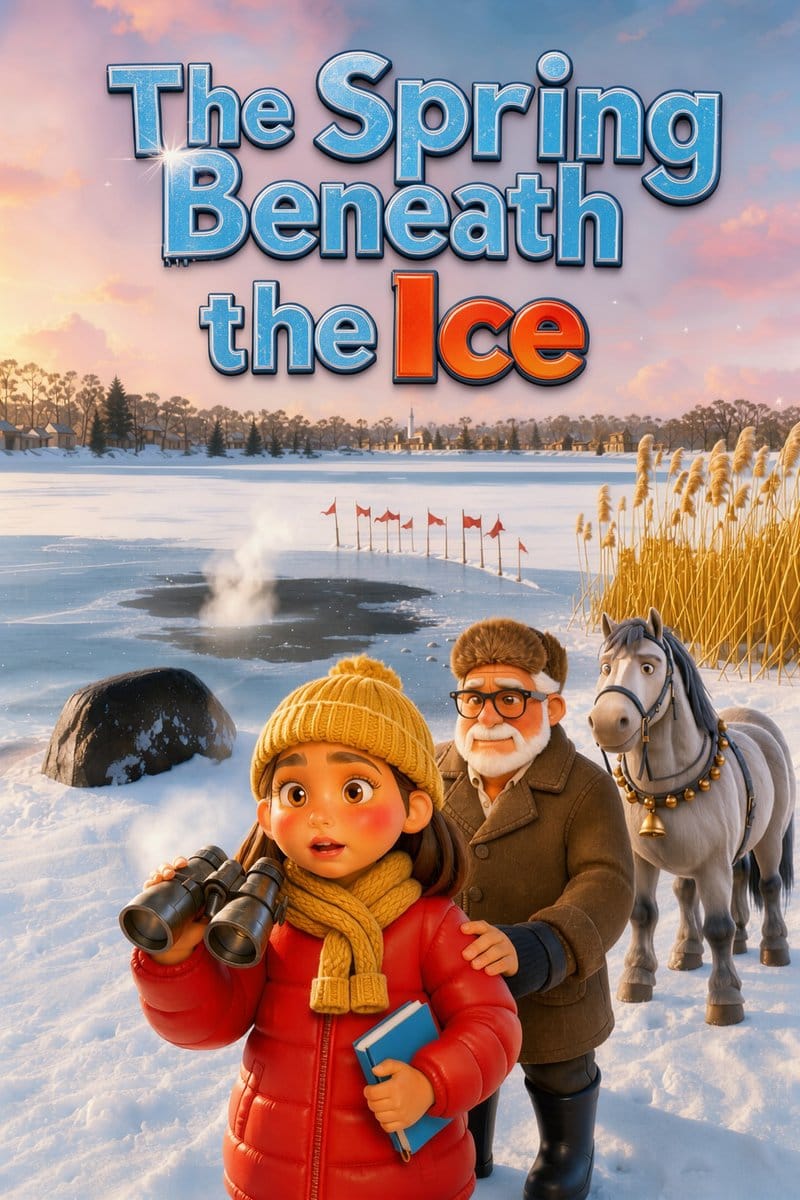
The Spring Beneath the Ice
Lake Çıldır has frozen over, and at night it sings its long, mysterious songs. One Tuesday morning, Lily spots a dark patch right beside the sledding path, where the snow has melted away. Before the tourist buses arrive on Saturday, can she discover why the ice has grown thin there, without ever setting foot on it? And can she get the sledding path moved in time?
Free story — no account needed to read it.
15 Minutes
4 Endings
9-10
auto_stories Similar Stories

About This Story
“The Spring Beneath the Ice” is an interactive adventure story for children aged 9-10, about 15 minutes long. The reader decides how it goes at 5 choice points, and there are 4 different endings. It is free to read on Kitapz, with no account needed.
- Age range
- 9-10 years
- Reading time
- about 15 minutes
- Genre
- Adventure
- Format
- Interactive · 5 choice points · 4 endings
- Language
- English, Turkish
- Access
- Free, no account needed
- Characters
- Ben, Lily, Smoky, Oliver, Tourists, Grandpa Harry, Sledders, Granny Grace, Mayor Sylvia
- Collections
- Adventure stories, Stories for ages 9-10
- Reading support
- dyslexia-friendly font, bionic reading, color-blindness filters
An Excerpt from the Story
Lily had come from the city, and on the first night of her winter break she woke up in the stone house of her grandfather, Grandpa Harry the fisherman. A long, thin sound was coming from the lake. First it groaned, then it stretched out like a whistle, then it suddenly stopped. Lily pulled on her wool socks and ran to the kitchen.
Grandpa Harry tossed a log into the stove, and the fire roared.
Grandpa Harry:
“Don't be scared, sweetheart. When the night gets cold, the ice shrinks and cracks. Thick ice makes that sound every winter. Nothing's wrong.”
Lily opened her notebook and drew the sound as wavy lines. Her shivers were gone, and curiosity had taken their place.
Grandpa Harry:
“One more thing. Grown-ups measure the ice, and children never step on it. Everyone in this village knows that.”
Lily wrote the rule at the very top of the first page of her notebook.
“The Spring Beneath the Ice” · Ages 9-10 · kitapz.com
school For Parents and Teachers
In this story, children join Lily as she investigates a dark patch of ice beside the sled trail on Lake Çıldır from the shore, recording measurements, observing carefully and listening to village elders. The story teaches ice safety and takes seriously Oliver's fear of losing his winter income. Readers' choices decide which evidence Lily follows and how she shares it.
What will children learn from this story?
- Learns that a measurement only tells you about the spot where it was taken, and that lake ice is not the same thickness everywhere.
- Practices bringing different kinds of evidence together, such as measurements, careful observation and what older people remember.
- Learns basic ice safety: grown-ups test the ice, children stay on the shore, and dark, lead-colored ice is a warning sign.
- Thinks about how to warn people about a danger while caring about the person whose living depends on the outcome.
Curriculum links: Science, Maths, Life skills
Fact Box
Where is Lake Çıldır, and does it really freeze?
Lake Çıldır lies between the provinces of Kars and Ardahan in northeastern Türkiye and, at 123 square kilometers, is the largest freshwater lake in the Eastern Anatolia Region. It freezes in December and the ice keeps thickening as winter goes on; local fishers break through it with picks and shovels and leave their nets in the water below for a day or two.
Source: GoTürkiye
Why does a frozen lake make strange sounds?
Big temperature changes make the ice sheet crack, and each crack releases energy as vibrations that travel through the ice. High-pitched vibrations move faster through ice than low ones, so the high tone reaches your ear first with the low tone right behind it, which gives the ice its odd, sliding, whistle-like sound.
Source: Discover Magazine
What does the color of ice tell you about its strength?
Clear blue ice is the strongest, while white, cloudy ice formed when wet snow freezes on top is only about half as strong. Grey ice is unsafe, because the grey color shows there is water in it.
How thick does lake ice need to be to walk on?
Parks Canada recommends ice at least 15 cm (about 6 inches) thick for one person walking or skating, and at least 20 cm (about 8 inches) for skating parties or games. Thickness is checked by drilling a hole, and it depends on many things, including the location, the depth of the water and changes in air temperature.
Reading Comprehension Questions (5W1H)
The questions cover the opening that every reader sees, whatever they choose. Tap a question to see the answer.
-
Who? Who does Lily think needs to know about the dark spot?
Answer: Oliver, Ben's big brother, because he drives his sled on that trail every weekend.
-
What? What rule does Grandpa Harry say everyone in the village knows?
Answer: Grown-ups measure the ice, and children never step on it.
-
Where? Where does Lily see the dark spot?
Answer: Right beside the sled trail, where the snow has melted and the ice has turned dark like lead.
-
When? When are the buses coming from Kars?
Answer: On Saturday, the day circled in red pen on the calendar.
-
Why? Why do the Saturday tours matter so much to Oliver?
Answer: Smoky's feed and all the money he makes this winter come from those tours.
-
How? How did Oliver decide the ice was safe?
Answer: He drilled and measured it at the start of the trail on Monday and found it was fifty centimeters thick.
Questions to Talk About After Reading
- At the first choice, did you send Lily to ask Granny Grace about the old story, or have her convince Grandpa Harry to measure beside the trail? Why did you choose that path?
- In the barn, the words got stuck in Lily's throat. Have you ever found it hard to tell a grown-up something you thought was right? What would help you speak up?
- Oliver's winter income depends on the sleigh rides. Why might it matter to think about what someone could lose when you warn them about a danger?
- What safety rules do you follow at home, at school or near water? Why do you think those rules were made?
Word List
- harness
- A set of straps that fastens a horse to a sled or cart so it can pull it.
- reed
- A tall, thin, grass-like plant that grows thickly in shallow water at the edge of a lake.
- ice drill
- A hand tool that is turned round and round to bore a hole through ice so its thickness can be measured.
- trough
- A long, open stone container that water collects in, like the one under the village fountain.
- spout
- The short pipe or opening that water pours out of.
- minaret
- A tall, slender tower next to a mosque.
Activity Idea
Make a measuring map like Lily's: choose a short path in a park or schoolyard, stop every few steps to measure the snow depth with a ruler (or the grass height if there is no snow), and write each number on a drawing of the path. Then talk about where the numbers changed and why one measurement might not be enough, and stay off frozen puddles and ponds the whole time.
Completion Rewards
What you'll earn when you finish this story: