Bearings: A Spot at Sea
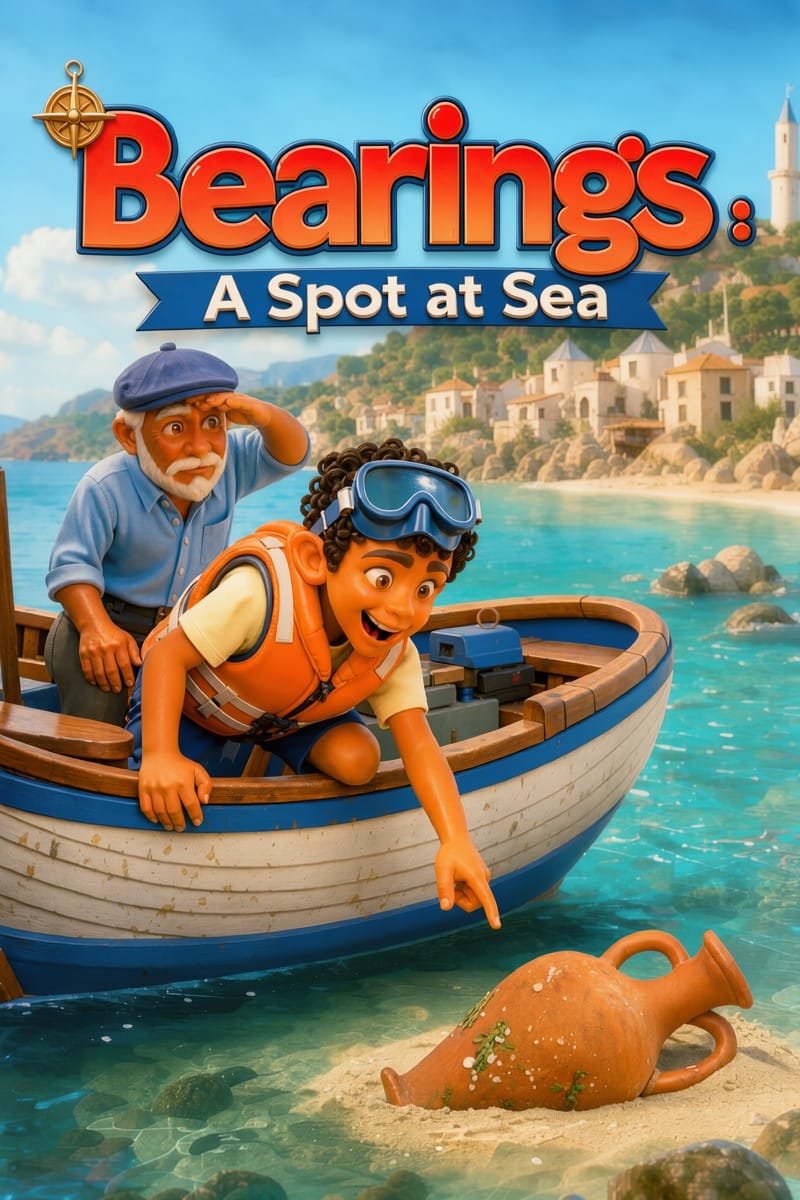
While looking out from his grandfather's boat in Palamutbükü, Caleb spots an old two-handled amphora half buried in the sand. He makes a note of where it lies, but the next morning, one of the landmarks he chose has vanished from the cove! Can he find the spot again, a place on the open sea that leaves no trace at all, before the wind picks up and the museum divers arrive?
Free story — no account needed to read it.
8 Minutes
4 Endings
11-12
auto_stories Similar Stories


About This Story
“Bearings: A Spot at Sea” is an interactive adventure story for children aged 11-12, about 8 minutes long. The reader decides how it goes at 5 choice points, and there are 4 different endings. It is free to read on Kitapz, with no account needed.
- Age range
- 11-12 years
- Reading time
- about 8 minutes
- Genre
- Adventure
- Format
- Interactive · 5 choice points · 4 endings
- Language
- English, Turkish
- Access
- Free, no account needed
- Characters
- Daphne, Caleb, Tyler, Dr. Nora Atkins, Grandpa Ray, Mrs. Sylvia
- Values
- Responsibility, Honesty, Teamwork
- Collections
- Adventure stories, Stories for ages 11-12
- Reading support
- dyslexia-friendly font, bionic reading, color-blindness filters
An Excerpt from the Story
Caleb floated beside the boat in his orange life jacket, his mask down in the water, looking at the rocks on the seabed. All of a sudden he saw a round handle poking out of the sand, and right beside it, a second one.
Four or five meters below, half buried in the sand, lay an old jar with two handles.
Caleb (thinking):
It's an amphora! A real amphora!
He lifted his head out of the water and remembered what Grandpa Ray had taught him: to remember a spot at sea, you line up two things on the shore, one behind the other. Caleb picked the first thing he saw. There was something white near the shore, and right behind it stood one of the windmills on the hill.
When he climbed back into the boat, Grandpa Ray was bent over the net at the stern. He didn't look up.
Caleb:
“Grandpa, there's an amphora down there! The white thing and the windmill line up!”
Grandpa Ray:
“Good for you. Write it down. Don't trust your memory.”
“Bearings: A Spot at Sea” · Ages 11-12 · kitapz.com
school For Parents and Teachers
In this story, children help Caleb find a spot at sea using landmarks on the shore, and learn from his mistake why a good landmark must never move. The story looks at protecting an ancient find where it lies and weighing evidence such as a phone pin, a photo and a fisherman's memory. Readers' choices decide whose knowledge Caleb trusts.
What will children learn from this story?
- Learns how to mark a spot at sea by lining up two landmarks on the shore, and that the point where two such lines cross shows the exact place.
- Learns that a landmark has to be something that stays put, like a minaret, a lone pine or a headland, not a boat that can sail away.
- Learns that an ancient find should be left untouched and reported to the village head or the museum, and why its location is kept quiet.
- Practises comparing different kinds of evidence, such as a phone's location pin, a photo and people's memories, and deciding how far to trust each one.
Curriculum links: Social studies, Maths
Fact Box
What is an amphora?
An amphora is a jar with two vertical handles that people in ancient times used to store and transport foods such as wine, olive oil, honey, olives and dried fish. Over time its base became a spike, a shape suited to carrying wine and packing jars together, and amphorae were packed into sailing ships to cross the ancient Mediterranean.
Source: World History Encyclopedia
How can you fix a position at sea using landmarks on the shore?
When two landmarks appear one directly behind the other, you are somewhere on a straight line running through both of them, which sailors call a transit. The point where at least two such lines cross gives your position, known as a fix.
Source: Wikipedia
What should you do if you find an ancient object in Turkey?
Under Turkish law, anyone who finds a cultural property must report it within three days to the nearest museum directorate, to the village head (muhtar) in a village, or to the local government administrator in towns and cities. Searching for antiquities, with or without a detector, is not allowed.
How accurate is the location on a phone?
Under open sky, GPS-enabled smartphones are typically accurate to within about 4.9 m (16 ft). Buildings, bridges and trees that block the satellite signals can make the error larger.
Source: GPS.gov
Reading Comprehension Questions (5W1H)
The questions cover the opening that every reader sees, whatever they choose. Tap a question to see the answer.
-
Who? Who does Grandpa Ray go to after Caleb finds the amphora?
Answer: He goes straight to Mrs. Sylvia, the village head, who then calls the museum.
-
What? What can be seen in the photo Daphne took on the beach that morning?
Answer: The sea, a red rock and a white gulet anchored in the background.
-
Where? Where does Caleb write down the spot?
Answer: On the last page of Grandpa Ray's fishing notebook, as "white thing - windmill".
-
When? When can the museum divers come, and when will the wind pick up?
Answer: The divers can come in two days, but the wind will pick up the next afternoon.
-
Why? Why can't Caleb find the amphora the next morning?
Answer: His "white thing" was not the minaret but a gulet anchored near the shore, and it sailed away during the night.
-
How? How did Grandpa Ray teach Caleb to remember a spot at sea?
Answer: By lining up two things on the shore, one behind the other.
Questions to Talk About After Reading
- At the first choice, did you send Caleb to Datça harbor to find the gulet, or keep him in the cove to look for clues? Why did you pick that path?
- When Caleb realizes his landmark was a boat, he turns red but tells Grandpa Ray straight away, and Grandpa Ray admits he thought it was the minaret too. Is it hard for you to admit a mistake? What changes when you say it out loud instead of hiding it?
- Mrs. Sylvia stops Daphne from posting her photos. What should you think about before you share a photo or a piece of news online?
- The story has a phone, photos, people's memories and landmarks on the shore. If you wanted to check where something is, which would you trust most? Why?
Word List
- amphora
- An ancient clay jar with two handles and a narrow neck, used for carrying things like wine and olive oil.
- buoy
- A floating marker tied to the seabed with a rope, used to show a spot in the water.
- gulet
- A wooden sailing boat, usually with two masts, that takes visitors on trips along the coast of Turkey.
- stern
- The back end of a boat.
- headland
- A piece of high, rocky land that sticks out into the sea.
- minaret
- The tall, thin tower of a mosque, which can be seen from far away.
Activity Idea
Take bearings like Caleb in a yard or schoolyard: hide a small stone, write down two pairs of fixed things that line up from where it lies (a tree and a lamppost, a door and a window), and let a friend find it using only your notes. Then try again with a chair or a ball as one of the landmarks, move it, and talk about what goes wrong.
Completion Rewards
What you'll earn when you finish this story: